

How to stop worrying and love radiant heating.
July 20, 2026
By Douglas Delange
For high-end customers looking to design and build their dream home or getaway, a hydronic radiant floor heating and cooling system represents more than just the pinnacle of comfort, it’s a technological marvel they can show off to friends, business associates and family. Being able to open 12-foot sliding glass walls when it was 104 F outside and holding a comfortable 70 to 73 F inside the home, or pulling up an app to cool off the guest room at the touch of a button, extends the comfort equation into an opportunity to position their home as a showcase.
Yet radiant floor cooling remains an uncommon alternative to air conditioning in residential homes. Why? It’s a commonly misunderstood system, with many contractors and designers fearing condensation buildup on floors and lacking the proper controls to manage dew point, which are two of the primary challenges associated with radiant floor cooling.
 Building a real-world test site
Scott Grimshaw, a veteran Canadian HVAC contractor and distributor, proved that radiant floor cooling can be a success by using his own custom-built 4,000-square-foot home overlooking Kalamalka Lake in British Columbia as a test site to show that proper smart controls, dew point management and hydronic fan coils can make the system a practical, reliable and comfortable option in residential homes.
Grimshaw spent 25 years specializing in custom homes, geothermal systems, hydronic heating systems, and radiant floor installations with his HVAC contracting company. He now runs Granite Hydronic Supply with his son, distributing hydronic heat pumps, fan coils and Tekmar controls to contractors across the region. During his time as a contractor, smart controls were not yet an option when installing radiant floor cooling.
Before smart controls became available, contractors would first design the geothermal or boiler system, install the piping, and then install the equipment. Everything wouldn’t come together until the end, when they’d go into the mechanical room and struggle to figure out how to connect all the equipment together. Controls took a backseat as contractors focused on installing the heat pump and piping. This made it difficult for contractors to troubleshoot and repair issues, and they frequently dealt with occupant complaints and callback requests
But now, by considering smart controls early in planning, radiant floor cooling has become a practical option that addresses many of the issues that would arise when controls were added after installation.
 Designing the system
Grimshaw wanted a single, integrated hydronic system with heating and cooling, humidity control, zoning and remote monitoring. The home itself was also built with a tight building envelope, minimizing air leakage and maximizing its energy efficiency. The hydronic system was built around an air-to-water heat pump that provides warm water for heating and chilled water for cooling. Specifically, Grimshaw selected air-to-water monobloc heat pumps due to their compatibility with hydronic radiant systems and smart controls.
 Zones
Zones
Radiant heating and cooling were achieved through eight separate zones throughout the home: four upstairs and four downstairs. On the lower level, Scott installed three inches of insulation beneath a four- to five-inch concrete slab with radiant tubing embedded in the concrete. This was covered with engineered hardwood flooring. The design of the upper level included tubing above the subfloor with a two-inch lightweight concrete pour, also covered with the same hardwood. Spacing was a deliberate choice, with six-inch on-centre spacing everywhere throughout the home. Although most contractors vary spacing, Grimshaw methodically kept it consistent because it allows the system to perform more efficiently. His spacing method creates a larger radiator, which ultimately enables lower water temperatures, improves heating efficiency and cooling performance, reduces hot and cold snaps, and creates more uniform comfort throughout the house.
 Fan coils
In addition to the radiant zones, hydronic fan coils were integrated into the system. The fan coils serve two purposes: humidity removal and supplemental cooling.
Within the home, fan coils were added to the following rooms…
- Guest bedrooms shared a fan coil;
- Main living spaces had larger fan coils;
- The master suite had a dedicated fan coil;
- Bathroom areas received humidity management support.
Flooring
One distinct design choice of the home was area rugs resting on the hardwood floors with no wall-to-wall carpeting. In a home with a hydronic system, these flooring selections support efficient heat transfer and help maximize radiant system performance.
Why controls came first in early planning
Grimshaw’s radiant cooling system would not have been possible without its connection to smart controls – specifically, his decision to integrate smart controls early in the design process. Drawing from his personal experience as an HVAC contractor, when his company grew to more than 12 trucks and his crews were spread over multiple projects, Grimshaw realized that building these systems by memory was unrealistic. He then turned to Tekmar and began using a control-first approach.
 Smart heat pump control
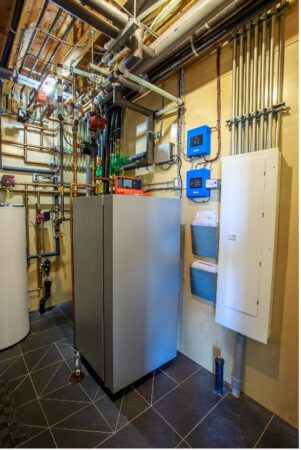
Grimshaw wanted a system that could manage cooling, heating, humidity, eight zones and communicate between multiple devices. He found the solution in the Smart Heat Pump Control 291, a smart hydronic control from Tekmar. This connected device performs as the central control platform, communicating with the other Tekmar products that Grimshaw installed: 557 Thermostats, 306V Wiring Centers, and the 295 Smart Mixing Control to complete his system. The thermostats are located throughout the home’s eight zones. The wiring centres help coordinate communication between the zones and controls, and the Smart Mixing Control regulates water temperatures for radiant cooling operations. Once the controls are selected, Tekmar provided mechanical application drawings and wiring diagrams to help the rough-in crew know exactly what wires needed to be pulled and where they needed to go before the walls were closed up. Mechanical application drawings show how the heat pump should be piped, how radiant zones should be connected, and how fan coils fit into the overall system architecture. Grimshaw made sure these diagrams were laminated and displayed in the mechanical room for easy reference during construction. The wiring diagrams show thermostat locations, wiring requirements, zone control connections, and communication between controls and equipment. Working through these diagrams early in the project helps avoid situations where contractors end up standing in a mechanical room trying to figure out how everything works. It’s something Grimshaw connects to the philosophy in Atul Gawande’s The Checklist Manifesto: the idea that even experienced professionals miss things without a written plan.
Making radiant cooling work
Radiant heating is rarely the problem for contractors; radiant cooling is. Radiant cooling can introduce a series of complications, including increased callbacks and liability due to the dew point, which poses risks of moisture damage. With smart controls, the thermostat actively measures room temperature and relative humidity, calculating the room’s dew point. This thermostat then reports its measurements to the smart heat pump control, which determines and signals the maximum safe temperature for the radiant floor without causing condensation – one of the largest concerns contractors face with radiant cooling. Fan coils must also be installed, as they help address condensation by removing the humidity that radiant floors cannot handle on their own.
 Two-stage cooling strategy
Stage 1: Radiant floor cooling. The floor quietly absorbs the heat with no drafts or air blowing around, just comfortable cooling.
Stage 2: Hydronic fan coils. When cooling demand increases, fan coils activate, humidity is removed, and additional cooling is provided. The fan coils serve as the system’s humidity-management component.
The use of fan coils for humidity removal is essential because the fan coils intentionally condense water. The condensate then drains away, lowering indoor humidity. As humidity drops, the dew point falls, allowing the radiant floor to safely operate at lower temperatures without posing a condensation risk. The fan coil and radiant floor systems work symbiotically to maintain peak performance and comfort.
Occupant comfort
The technical performance is vital to achieving the ultimate goal: occupant comfort.
For Grimshaw, living with the installed full hydronic system resulted in exceptional comfort in the home, including:
- No blasts of cold air;
- No dramatic and noticeable temperature fluctuations;
- Stable comfort;
- Cool surfaces;
- Quiet operation;
- More even temperatures throughout the home.
 After experiencing two full summers of successful radiant cooling operation with no condensation issues, Grimshaw’s home is living proof of the system’s reliable comfort. By pairing radiant cooling with humidity management and smart controls in early planning, he avoided any signs of moisture damage.
Seven takeaways
- Integrate smart controls early in the process. Doing so makes the project much less intimidating;
- Determine how many zones are needed at the outset;
- Evaluate which rooms need fan coils, which rooms can share equipment, and which require individual control;
- Once those decisions are made, focus on the thermostats and wiring plans then begin construction;
- Mechanical drawings are critical because they clearly display piping layouts, equipment connections, and system architecture;
- Wiring drawings matter just as much. When wiring is planned during rough-in, the correct wires are already in place, everything is where it needs to be and contractors aren’t scrambling during startup;
- Hydronics is more than heating. When paired with connected controls, they can also support cooling, humidity management, smart controls and remote monitoring, all within a single integrated system.
The success of Grimshaw’s project testifies that radiant floor cooling need not be feared. With modern smart controls capable of implementing multiple system functions and supporting early-stage planning, contractors can confidently approach hydronic systems for radiant heating and cooling to deliver their customers the ultimate comfort experience.